How can companies improve team collaboration and break silos?
Practical ways to improve collaboration across teams and functions — building trust, making dependencies visible, aligning goals and agreeing how teams work together.
Key takeaways
- Silos are usually about trust and shared goals, not only structure.
- Collaboration improves when teams can see how their work depends on each other.
- Psychological safety — being able to speak up without fear — underpins candid collaboration.
- Explicit working agreements turn good intentions into habits.
Companies improve team collaboration by building trust between the people involved, making the dependencies between teams visible, aligning everyone around shared goals, and agreeing explicit ways of working — then practising and reinforcing those habits. Structural changes can help, but collaboration is ultimately a relational capability.
Why silos form
Silos rarely start with bad intent. Teams specialise, build their own priorities and metrics, and gradually lose sight of how their work affects others. Over time, familiar patterns appear:
- Information stays inside a function.
- Problems are handed "over the wall" rather than solved together.
- Teams optimise for their own targets, sometimes at the expense of shared outcomes.
- Conflict between functions becomes a story about the other team rather than a shared problem.
1. Build trust between people, not just teams
Collaboration depends on people being willing to rely on each other, share incomplete information and raise problems early. That requires trust — and trust between functions is usually built person to person.
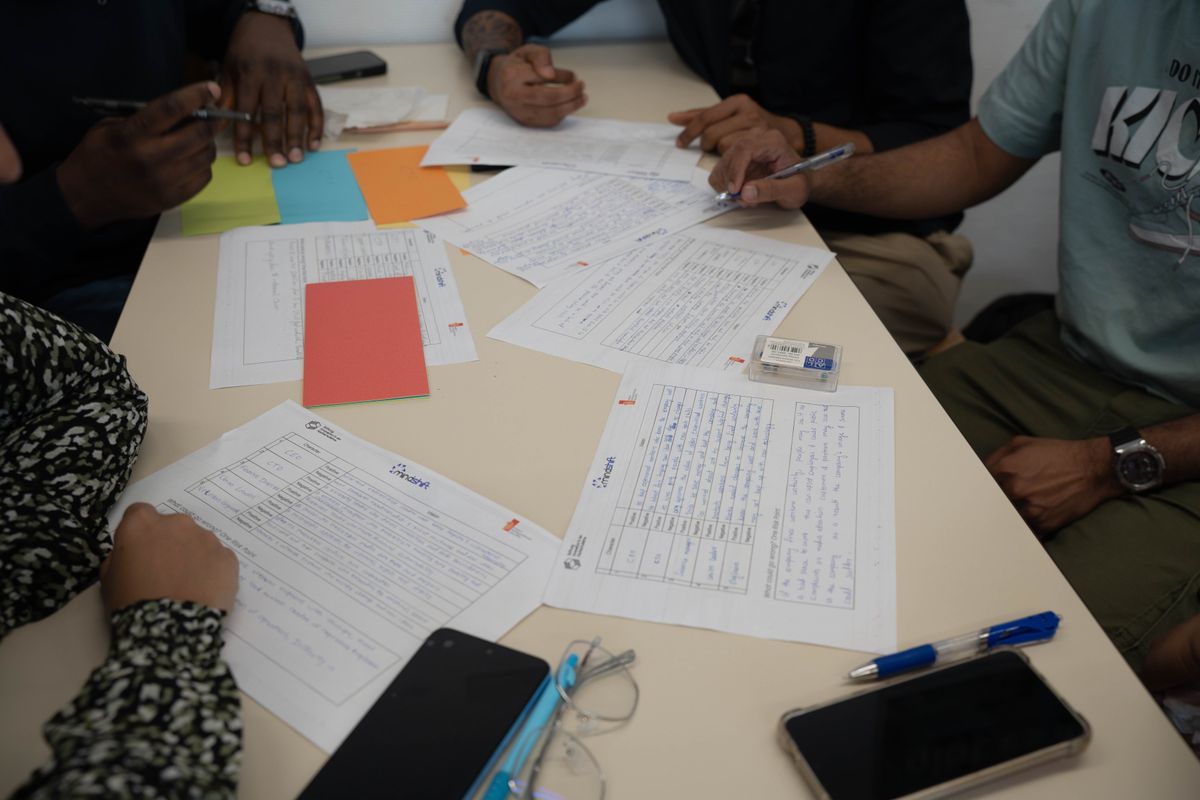
Shared experiences help. When people from different teams solve a challenge together, they learn how the others think, what pressures they face and what they are good at. This is one reason experiential team programmes, when followed by honest reflection, can shift cross-team relationships faster than meetings.
2. Make dependencies visible
Teams often underestimate how much their work depends on others. Mapping the handovers between functions — where work, information and decisions move — makes the cost of silos concrete. Collaborative challenges that deliberately split information across groups can make the same point experientially: success depends on sharing.
3. Create psychological safety
Research by Amy Edmondson, beginning with her 1999 study of work teams, described psychological safety as a shared belief that a team is safe for interpersonal risk-taking. In teams with higher psychological safety, people are more willing to ask for help, admit mistakes and raise concerns — which is exactly what cross-functional collaboration needs.
Leaders shape this more than anyone. Asking for input, responding well to bad news and acknowledging their own mistakes all signal that candour is welcome.
4. Align on shared goals
When each team is measured only on its own targets, silos are rational. Collaboration improves when teams share at least some goals and understand how their individual goals connect to the overall outcome. Leadership alignment sessions that agree a small number of shared priorities — and who owns what — are often the starting point.
5. Agree how you will work together
Good intentions fade without explicit agreements. Useful working agreements between teams cover:
- How and when information will be shared.
- How requests are made and prioritised.
- How disagreements are escalated and resolved.
- How handovers work, and what "done" means.
Agreements are most effective when the teams create them together rather than having them imposed.
6. Address conflict early
Cross-functional friction is normal. What damages collaboration is friction that is avoided until it becomes personal. Building people's ability to raise issues early and have constructive difficult conversations is one of the most direct ways to protect collaboration.
7. Reinforce and revisit
Collaboration habits need reinforcement. Short check-ins on working agreements, recognition of good cross-team behaviour, and leaders modelling collaboration keep the change going after any programme or offsite.
The bottom line
Breaking silos is less about org charts and more about people: trust, visibility, shared purpose and agreed ways of working. Experiences that let teams feel their interdependence — followed by honest reflection and practical agreements — are one of the most effective ways to start.
Topics covered
- team collaboration
- breaking silos
- cross-functional teams
- trust
- team effectiveness
Frequently asked questions
Sometimes structure is part of the problem, but restructuring alone rarely fixes collaboration. Trust, shared goals and working agreements still need to be built between the people involved.
It is a shared belief within a team that it is safe to take interpersonal risks — to speak up, ask questions, admit mistakes or disagree — without fear of embarrassment or punishment. The concept is associated with Harvard professor Amy Edmondson's research.
Kraft Connect perspective
From learning design to business context.
This insight sits at the intersection of experiential learning and workplace application. Explore the people behind Kraft Connect for the facilitation and organisational perspectives that shape its programmes.

Kraft Connect's editorial team develops practical learning and development guidance from its experiential methodology and programme design work. The team works alongside founders Ishu Sharma and Sartaj Singh Mangat.